


MAXI/RBM timeseries data
Overview
Description
The Radiation Belt Monitor (RBM) is one of the instruments aboard MAXI. Its primary role is to count the number of charged particles every second, enabling automatic shutdown of the Gas Slit Camera (GSC) when MAXI enters regions with high particle flux such as the radiation belts.
RBM is also a useful sensor for investigating relativistic electron precipitation (REP) events. It can monitor energetic electrons at 1-s time cadence in two perpendicular directions (i.e., both horizontal and vertical directions), providing information on the pitch angle distribution of REP events at low energy.
Instruments
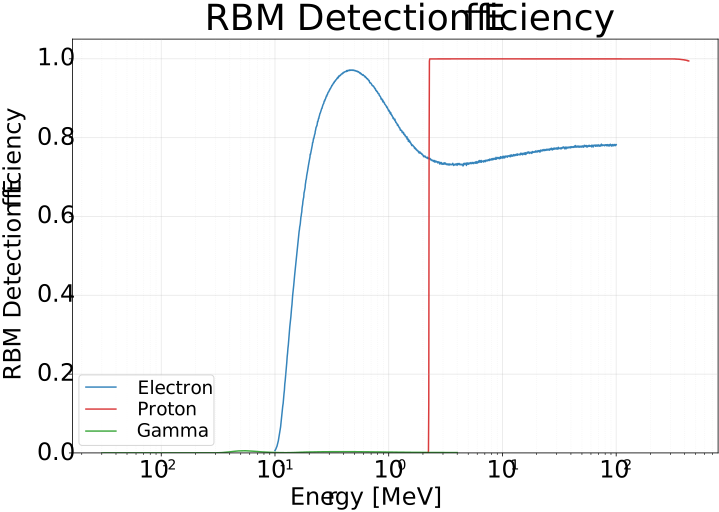
The RBM is a semiconductor detector (PIN diode) with a detection area of 5 mm × 5 mm and a thickness of 200 μm. It is sensitive to electrons above ~150 keV, while also responding to protons above ~3 MeV.
The opening angle of the RBM is equal to the collimator of each GSC unit, and it counts the number of charged particles entering through an 82° field of view. A 50 μm aluminum foil is attached to the entrance window, which is equivalent in charged particle transmittance to the 100 μm thick Be window of the GSC sensor.
The RBM has four selectable lower discriminator (LD) settings:
| LD | Threshold | Description |
|---|---|---|
| 0 | 30 keV | For ground testing; set near the electronics noise level |
| 1 | 50 keV | Sensitive to electrons at the MIP (minimum ionizing particle) level even with small energy loss; detects both electrons and protons |
| 2 | 200 keV | Sensitive to protons (2–100 MeV); not sensitive to electrons |
| 3 | 1 MeV | Reserved for noisy conditions; very high threshold |
Since the start of operations, LD = 1 (50 keV threshold) has been used as the standard setting.
The figure below shows the detection efficiency of the RBM.
Request for using this data
MAXI users are courteously requested to acknowledge in any resulting publications, as follows:
“This research has made use of MAXI data provided by RIKEN, JAXA and the MAXI team.”
and to cite the paper:
“The MAXI Mission on the ISS: Science and Instruments for Monitoring All-Sky X-Ray Images”, Matsuoka, M. et al., PASJ, 61, 999 (2009) [doi:10.1093/pasj/61.5.999]
MAXI team does not guarantee any results obtained from using the MAXI data and tools. When you change MAXI tools, please indicate that changes are made.
Keywords
Publication Date
2020
Temporal Coverage
from 2009-08-03
Identifier
- Title: MAXI/RBM timeseries data
- ID: darts:maxi-rbm-timeseries
- URL: https://darts.isas.jaxa.jp/datasets/darts:maxi-rbm-timeseries
Data Distribution
https://data.darts.isas.jaxa.jp/pub/maxi/rbm/ (application/x-netcdf, text/plain)
Data Structure (auto-generated summary)
pub/maxi/rbm/
├── 2009/
├── 2010/
├── ...
└── {YYYY}/
    └── mx_rbm_{YYYYMMDD}.cdf, .txt
Creator
- NAKAHIRA, Satoshi (中平 聡志), ISAS > Institute of Space and Astronautical Science (宇宙科学研究所) [ORCID: 0000-0001-9307-046X]
- ISAS > Institute of Space and Astronautical Science (宇宙科学研究所) [ROR: 034gcgw60]
Copyright Holder
- JAXA > Japan Aerospace Exploration Agency (宇宙航空研究開発機構) [ROR: 059yhyy33]
- ISAS > Institute of Space and Astronautical Science (宇宙科学研究所) [ROR: 034gcgw60]
License
References
- Matsuoka, M. et al. (2009) Publications of the Astronomical Society of Japan - The MAXI Mission on the ISS: Science and Instruments for Monitoring All-Sky X-Ray Images. https://doi.org/10.1093/pasj/61.5.999