


Web application for the data acquisition and display
We will introduce DARTS content that makes it easier to find the data you are looking for, such as a search system, Quick Look function, and data list.
Search data


Akebono Data Search is a tool that allows you to search for data and orbital data observed by the Akebono satellite.
Main Features:
- Extraction of orbit data
- LEP ET plot image search
- LEP-e, LEP-i data search (with ET plot images and SDB binary data)
- LEP SDB binary data search
- TED ET plot image search
- TED SDB binary data search
- SMS summary plot image search
- SMS SDB binary data search
- RDM Mapping plot data search
- RDM Flux versus L-value plot data search
- RDM Flux average plot data search
- ATV data search
Applicable satellite:
- AKEBONO
- EXOS-D
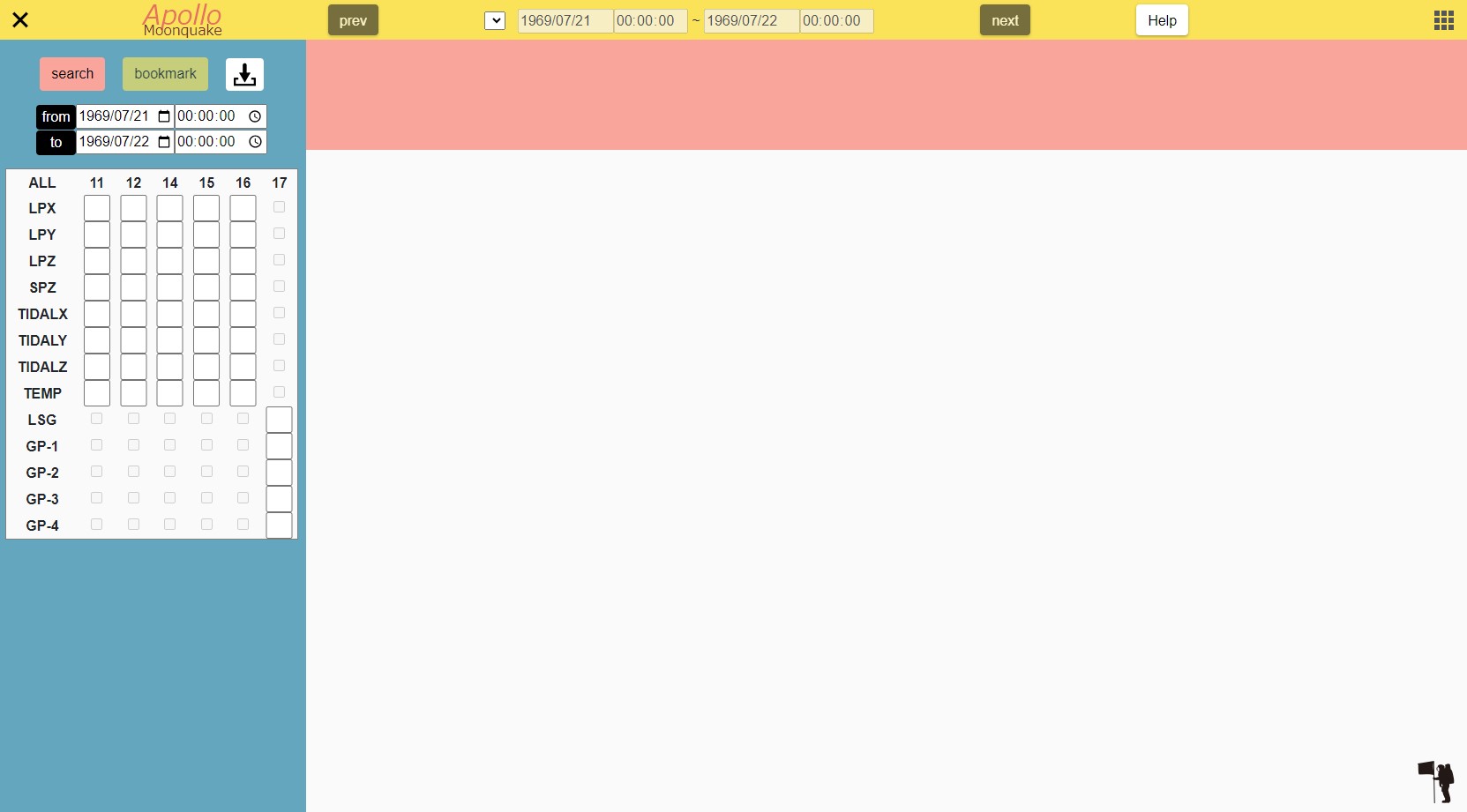
Apollo Moonquake Data Search (Apollo Moonquake) is a tool that allows you to search, plot, and download observation data from the seismometers installed on the Moon during the Apollo program.
Main Features:
- Search, plot display, and download of Apollo seismometer observation data in CSV or D5A format
Applicable satellite:
- APOLLO
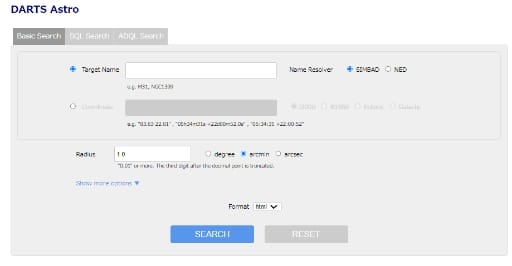
DARTS/Astro Query System is a tool that enables cross-searching of various astronomical observation data, observation logs, and observation proposals (proposals) archived in DARTS.
Main Features:
- Allows searching of various astronomical observation data, observation logs, and observation proposals (proposals) archived in DARTS using the following three methods:
- Basic search: Circular search. Specify a target or central coordinates and a radius to cross-search various datasets.
- SQL search: Search specific datasets by freely entering SQL queries.
- ADQL search: Search specific datasets by freely entering ADQL queries.
- Enables access to data from the search results.
- Allows downloading of the search result list.
- Enables sharing of the search result URL as a permalink.
Applicable satellite:
- AKARI
- ASTRO-F
- ASCA
- ASTRO-D
- BSGC
- GINGA
- ASTRO-C
- HITOMI
- ASTRO-H
- IRTS
- SUZAKU
- ASTRO-E2
- VSOP
- HALCA
- MUSES-B
- XRISM

The Bennu Sample Database System is a tool that allows users to search for samples from the asteroid Bennu, which were brought back to Earth by the OSIRIS-REx spacecraft.
Main Features:
- Search for Bennu samples by name, size, weight, and other criteria
- Download search result lists in CSV or JSON format
Applicable satellite:
- CURATION
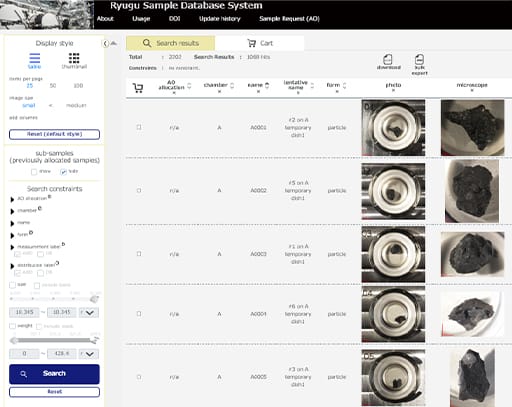
The Ryugu Sample Database System is a tool that allows users to search for samples from the asteroid Ryugu, which were brought back to Earth by the Hayabusa2 spacecraft.
Main Features:
- Search for Ryugu samples by name, size, weight, and other criteria
- Download search result lists in CSV or JSON format
Applicable satellite:
- CURATION

Geotail Data Search and Plot is a tool that allows you to output data observed by the Geotail satellite?such as magnetic field, electric field, and ion moments?in ASCII format, as well as plot graphs of the data.
Main Features:
- Interactive Plot: Plot graphs based on specified conditions
- Output data in ASCII format in the specified coordinate system
- ASCII Listing: Output data for magnetic field, electric field, and ion moments
- MGF High Resolution: Output high-resolution magnetic field data
- MGF Search Coil: Output high-resolution search coil magnetometer data
- LEP Ion Distribution: Output ion distribution function data
Applicable satellite:
- GEOTAIL
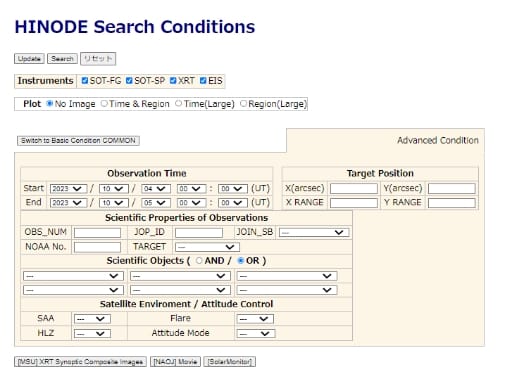
Hinode Data Search Systems is a tool that allows cross-searching of solar observation data collected by each instrument onboard the Hinode satellite.
Main Features:
- Enables batch search of Level-0 observation data from all instruments on the Hinode satellite
- In addition to observation date/time and observation region, detailed search conditions such as filter used and observation mode for each instrument can be specified
- Advanced Condition also allows searching for Preliminary Data
- QL image display function
- Data download function
- Output function for data download scripts (Wget, IDL)
- Plotting function for observation times and observation regions conducted within a specified date/time range
Applicable satellite:
- HINODE
- SOLAR-B

JAXA Asteroid Data Explorer 2 (JADE2) is a tool that allows you to search and display observation data of asteroid Ryugu collected by the Hayabusa2 spacecraft.
Main Features:
- Search, display, and download functions for observation data of asteroid Ryugu by the Hayabusa2 spacecraft
- Ability to obtain permalinks and share results
Applicable satellite:
- HAYABUSA2

SLNDEM App is a tool that allows you to search and display DEM (Digital Elevation Model) data generated using stereoscopic data from the Terrain Camera (TC) onboard the lunar orbiter Kaguya (SELENE).
Main Features:
- Search and display functions for lunar observation data obtained by the lunar orbiter “Kaguya” (SELENE)
- Mesh data download function
Applicable satellite:
- KAGUYA
- SELENE
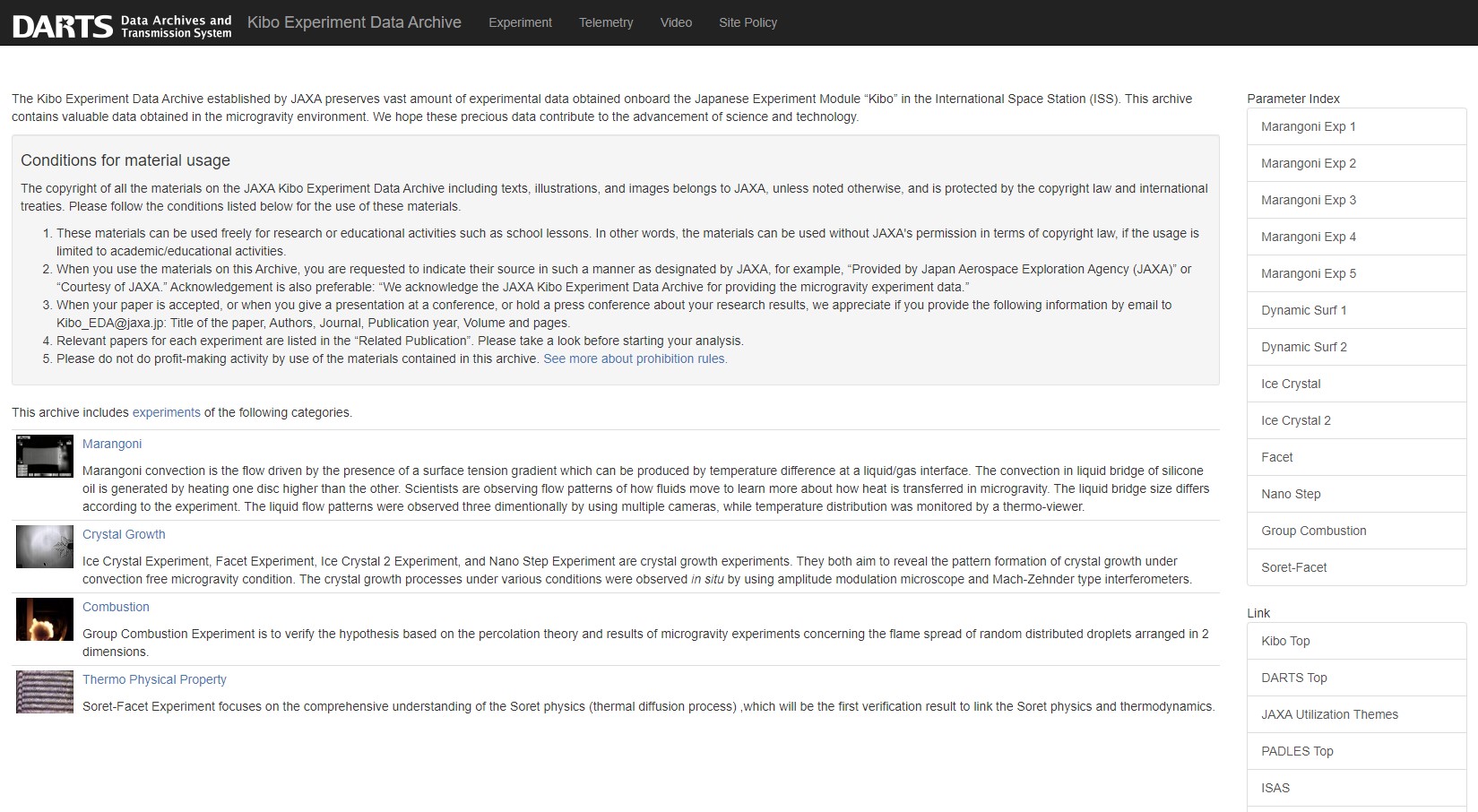
The Kibo Experiment Data Archive is a tool that allows users to search for and download onboard experiment data from the Japanese Experiment Module “Kibo” on the ISS.
Main Features:
- Search, quick look (QL) display, and download of onboard experiment data from the Japanese Experiment Module “Kibo” on the ISS
Applicable satellite:
- KIBO-PM
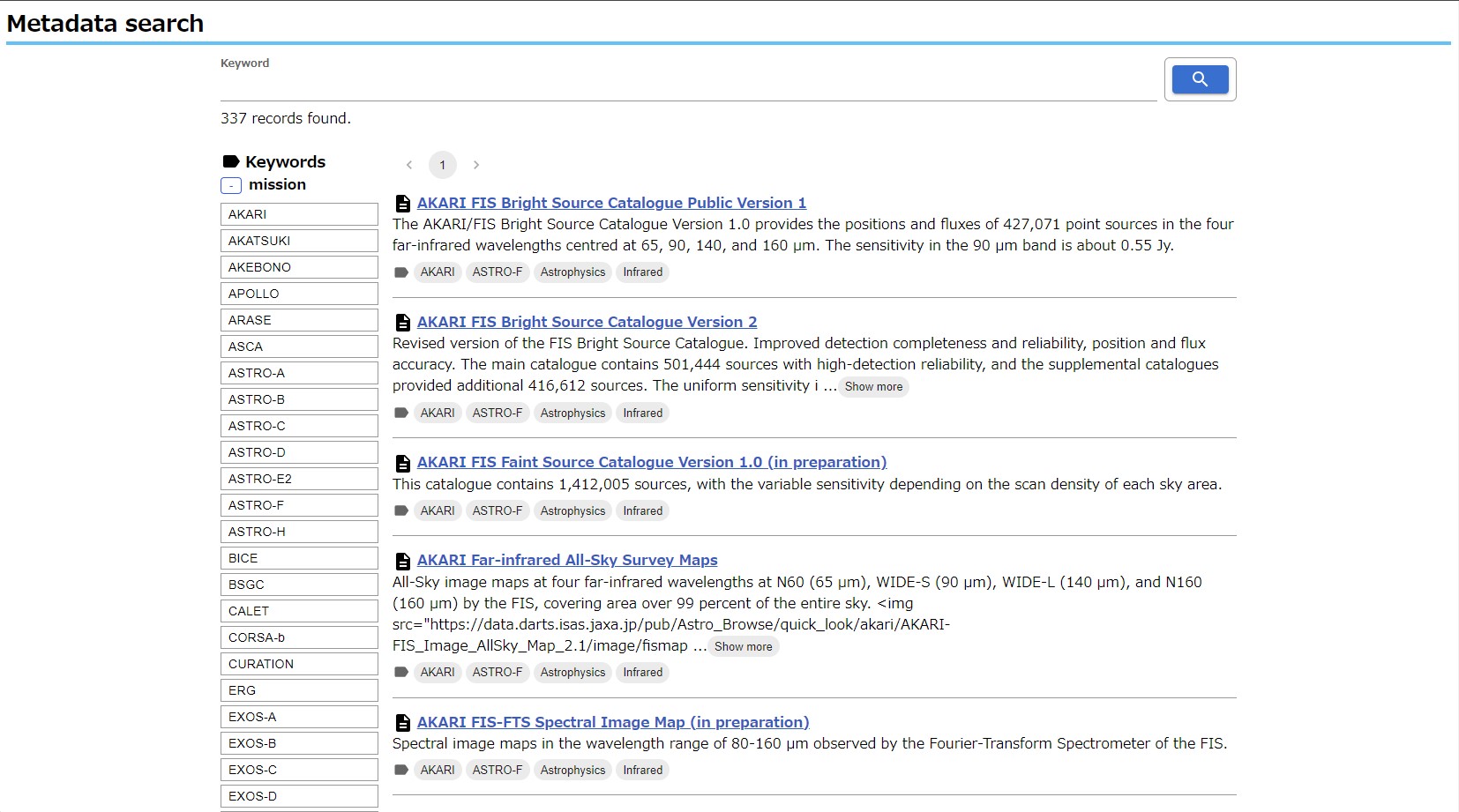
DARTS Metadata search is a tool that allows you to search across the numerous datasets archived in DARTS and display their metadata.
Main Features:
- Search datasets archived in DARTS using keywords such as mission name or research field
- View metadata (such as dataset overviews and related materials) for selected datasets
Applicable satellite:
- All
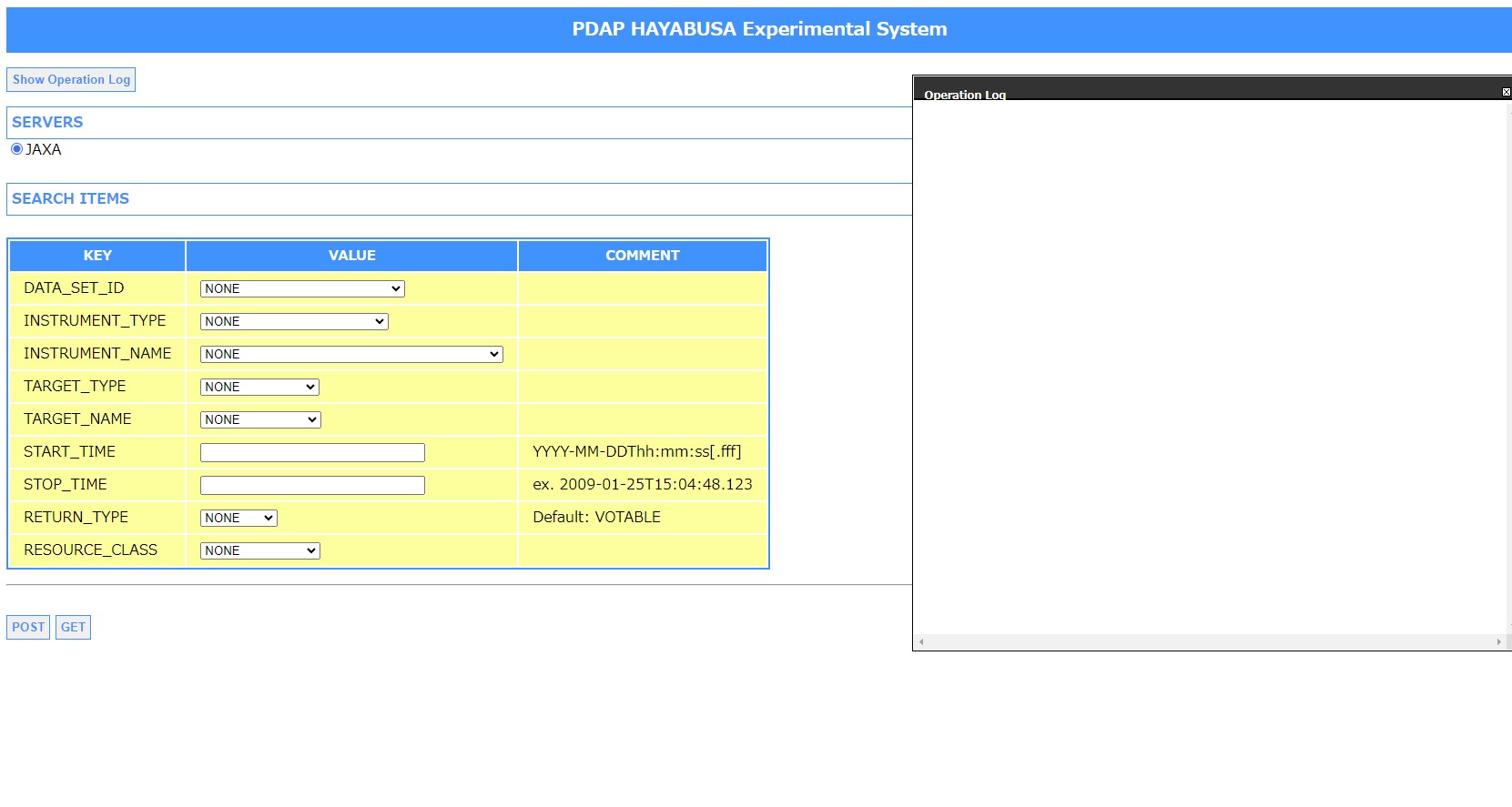
Hayabusa PDAP Search (PDAP HAYABUSA Experimental System) is a tool that allows users to search for observation data of asteroid Itokawa and others, collected by various observation instruments onboard the Hayabusa spacecraft.
Main Features:
- Search for datasets observed by Hayabusa
Applicable satellite:
- HAYABUSA
- MUSES-C
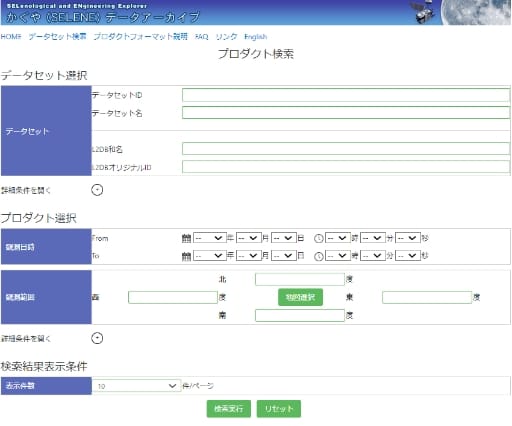
Kaguya (SELENE) PDAP Search (Selene Data Archive) is a tool that allows you to search for lunar observation data collected by the various observation instruments onboard the lunar orbiter Kaguya (Selene).
Main Features:
- Search for datasets observed by Kaguya (Selene) (DATA SET)
- Search for data products observed by Kaguya (Selene) (PRODUCT)
- In advanced search, you can enter more detailed conditions such as observation instrument and observation target for further filtering
Applicable satellite:
- KAGUYA
- SELENE

DARTS Time coverage is a tool that dynamically plots the periods during which data exists for each of the numerous datasets archived in DARTS.
Main Features:
- Dynamically plots the periods during which data exists for the selected datasets
- Allows you to change the display range of the time axis
- Enables downloading of the plot as an image (SVG, PNG)
- Allows downloading of the plotted data as a CSV file
- Generates a permalink to share the plot screen
Applicable satellite:
- All
QuickLook
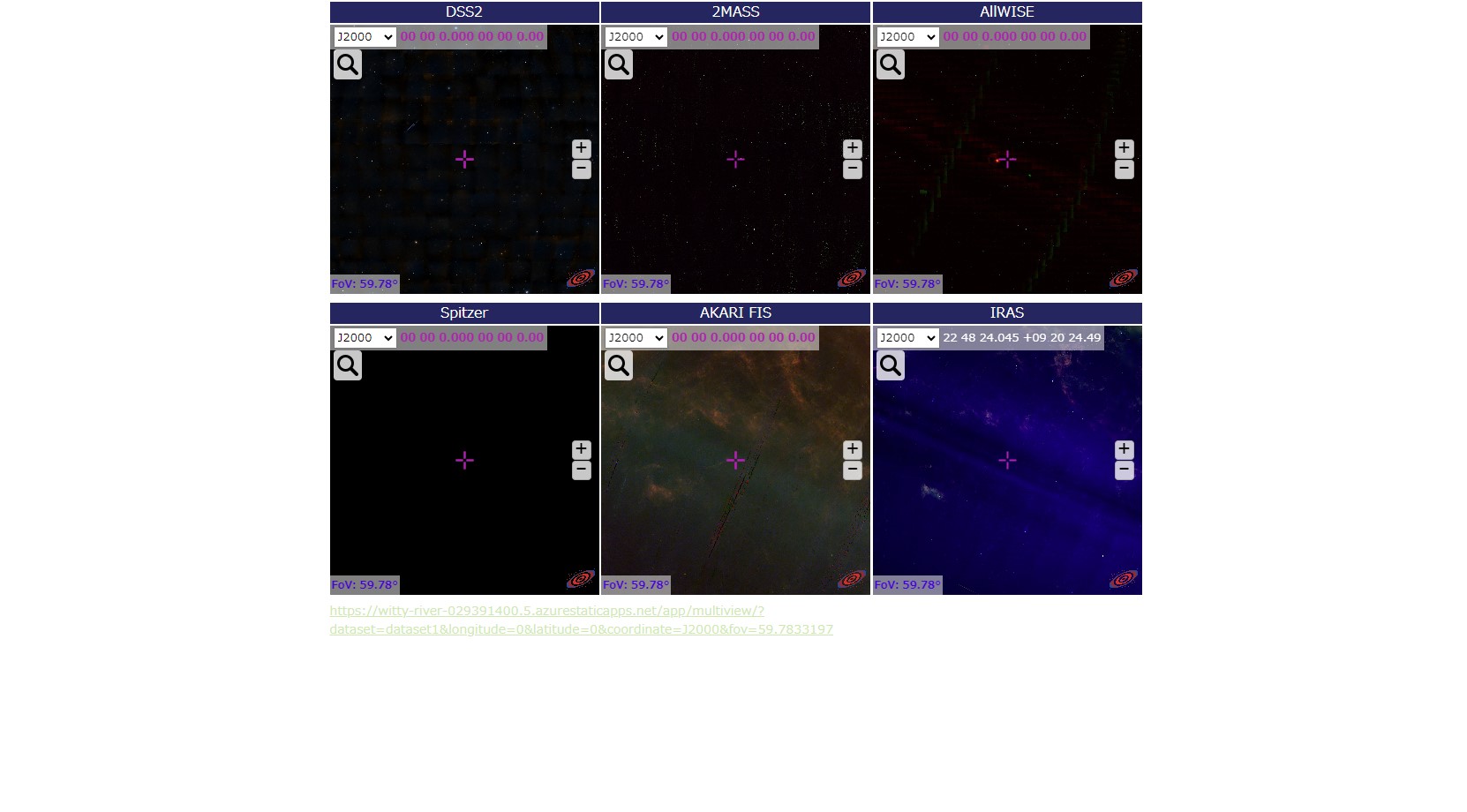
Aladin Lite Multiview is a tool that displays six Aladin Lite frames side by side, each showing space observation data from various satellites.
Main Features:
- Displays six Aladin Lite (https://aladin.cds.unistra.fr/AladinLite/) frames side by side, each showing observation data from different satellites
- When the display position or zoom is changed in any frame, the other frames are synchronized to show the same region at the same zoom level
- The six observation datasets to be displayed can be selected from the following sets:
- dataset1: DSS2, 2MASS, AllWISE, Spitzer, AKARI FIS, IRAS
- dataset2: CHIPASS, AKARI FIS, AllWISE, DSS2, ROSAT, Fermi
- dataset3: CHIPASS, CO, AKARI FIS for Bright source, Herschel SPIRE, Spitzer, Gaia EDR3
- dataset4: DSS2, GALEX GR6, ROSAT, MAXI GSC, Swift BAT, Fermi
Applicable satellite:
- AKARI
- ASTRO-F
- MAXI
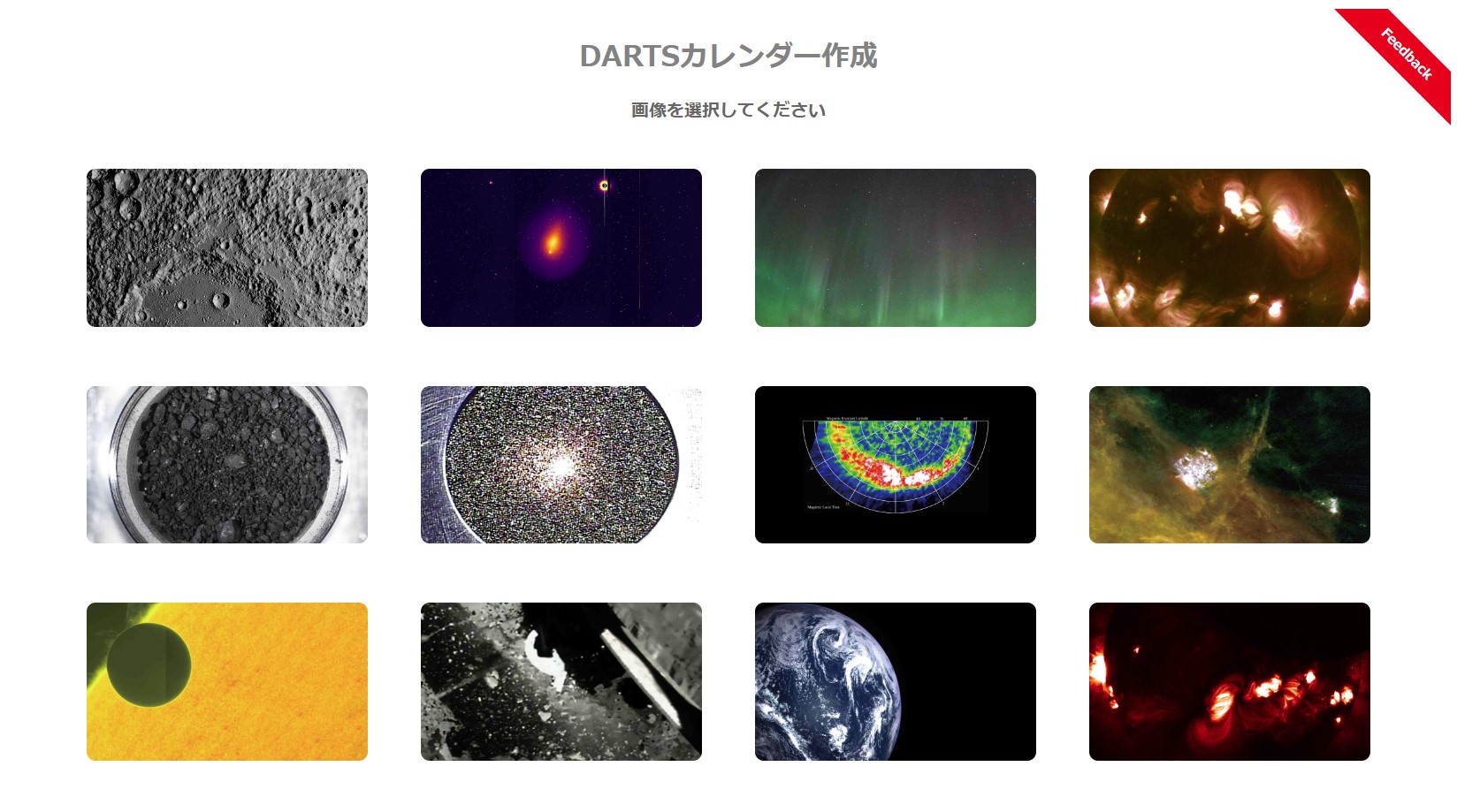
You can create a calendar for two months, three months, six months, or one year for each image in DARTS Calendar Maker.
Applicable satellite:
- HAYABUSA2
- AKATSUKI
- VCO
- CURATION
- HINODE
- SOLAR-B
- AKARI
- ASTRO-F
- MAXI
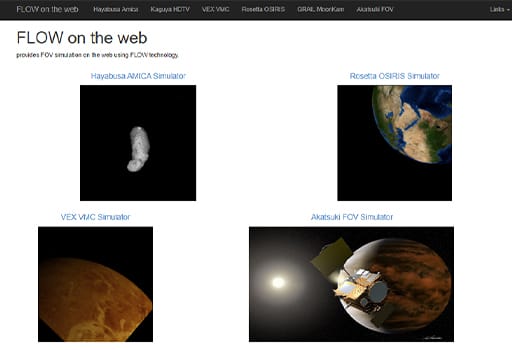
FLOW on the web is a tool that simulates and displays images of the field of view (direction being observed) of detectors mounted on spacecraft.
Main Features:
- Simulates and displays images of the field of view (direction being observed) of detectors mounted on each spacecraft for a specified date and time using a computer
- Allows you to specify detailed rendering methods through option selection, such as:
- Displaying images without shadows
- Displaying without applying textures
- Specifying the magnitude of stars to be rendered
Applicable satellite:
- HAYABUSA
- MUSES-C
- KAGUYA
- SELENE
- AKATSUKI
- VCO
- PLANET-C
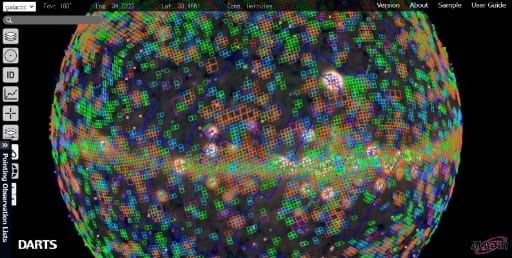
JUDO2 is a virtual celestial globe that displays space observation data captured at various wavelengths on a celestial sphere.
Main Features:
- Overlay the following on the celestial sphere:
- Observation images (on top layer, bottom layer, specify one each)
- Field of View (FOV) (on graphic layer, multiple FOVs can be specified)
- Celestial object catalogs (on graphic layer, multiple catalogs can be specified)
- Adjustable transparency for the top and graphic layers
- Access observation data from a list of observation IDs that appear in sync with the field of view
Applicable satellite:
- AKARI
- ASTRO-F
- ASCA
- ASTRO-D
- BICE
- GINGA
- ASTRO-C
- HITOMI
- ASTRO-H
- IRTS
- SUZAKU
- ASTRO-E2
- VSOP
- HALCA
- MUSES-B
- XRISM
- MAXI

JUDO2 has various functions, but JUDO2s is a simplified version of JUDO2 with fewer functions for easier operation.
Main Functions:
- Overlays two types of observation images on the celestial sphere
- Adjustable transparency of the foreground image
- Allows rotation, zooming in and out of the celestial sphere
Applicable satellite:
- AKARI
- ASTRO-F
- ASCA
- ASTRO-D
- BICE
- SUZAKU
- ASTRO-E2
- VSOP
- HALCA
- MUSES-B
- MAXI
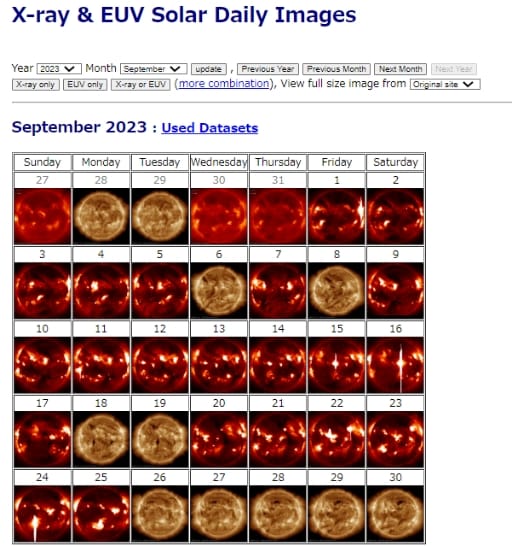
DARTS Solar Daily Images is a calendar that displays one solar observation image per day, captured in various wavelengths of light.
Main Features:
- Displays solar observation images in a monthly calendar format
- Allows selection of the following observation data:
- Full-disk solar observation images (X-ray) by Hinode satellite XRT (since October 2006)
- Partial solar observation images (visible light) by Hinode satellite SOT (since October 2006)
- Full-disk solar observation images (X-ray) by Yohkoh satellite SXT (from September 1991 to December 2001)
Solar Calendar is a calendar that displays one solar observation image per day, captured in various wavelengths of light.
Main Features:
- Displays solar observation images in a monthly calendar format
- Allows selection of the following observation data:
- Full-disk solar observation images (X-ray) by Hinode satellite XRT (since October 2006)
- Partial solar observation images (visible light) by Hinode satellite SOT (since October 2006)
- Full-disk solar observation images (X-ray) by Yohkoh satellite SXT (from September 1991 to December 2001)
Applicable satellite:
- HINODE
- SOLAR-B
- YOHKOH
- SOLAR-A

timescape (a time-series data display app) allows you to visualize the orbits and observation data of Hayabusa2 and Akatsuki at a specified time.
Main Functions:
- AKATSUKI: Displays the relative positions of Akatsuki and Venus, and the data observed by Akatsuki at that time.
- HAYABUSA2: Displays the relative positions of Hayabusa2 and asteroid Ryugu, and the data observed by Hayabusa2 at that time.
- orbits-all: Displays the relative positions of Akatsuki, Hayabusa2, Mio, Earth, the Sun, Venus, and asteroid Ryugu.
Applicable satellite:
- HAYABUSA2
- AKATSUKI
- VCO
- PLANET-C
- MIO
- MMO
- BepiColombo
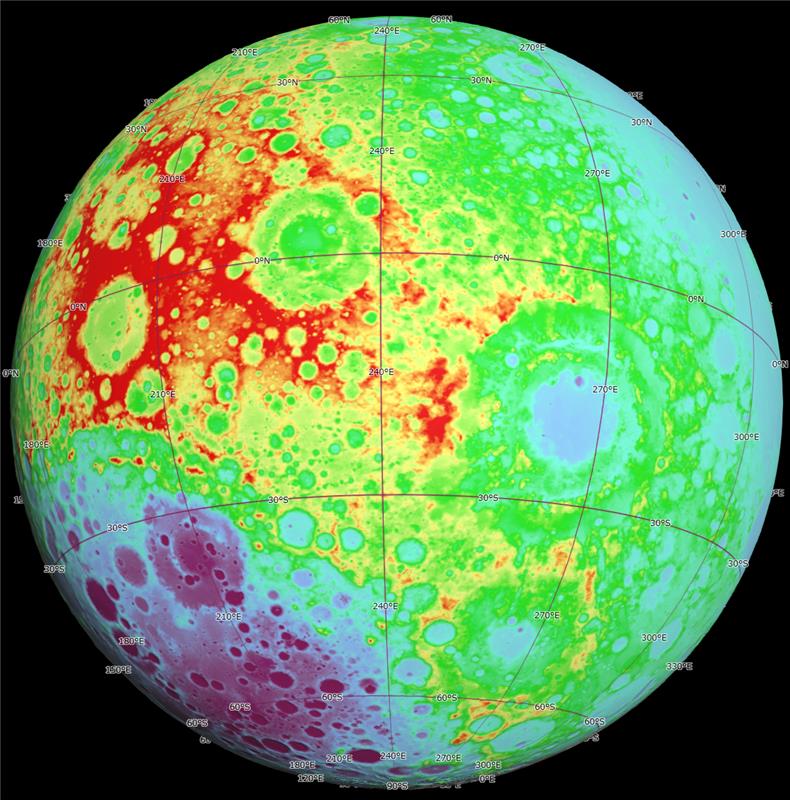
JAXA Virtual Planet (VP) is a system for analyzing observation data of the Kaguya spacecraft using a geographic information system.
Main Features:
- Display, analyze, and download functions for Kaguya observation datasets in raster and vector formats
- Ability to obtain permalinks and share results
Applicable satellite:
- KAGUYA
- SELENE
Simple analysis
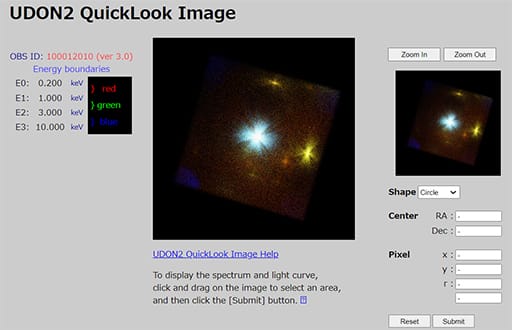
UDON2 (Universe via Darts ON-line) is a tool that allows for simple analysis of observation data from X-ray astronomy satellites available on DARTS via the web.
Main Features:
- Display of three-color composite pseudo-color images of observation data
- Plotting of spectra and light curves from observation data
- Cropping and zooming of displayed images are available
Applicable satellite:
- ASCA
- ASTRO-D
- HITOMI
- ASTRO-H
- SUZAKU
- ASTRO-E2
- XRISM
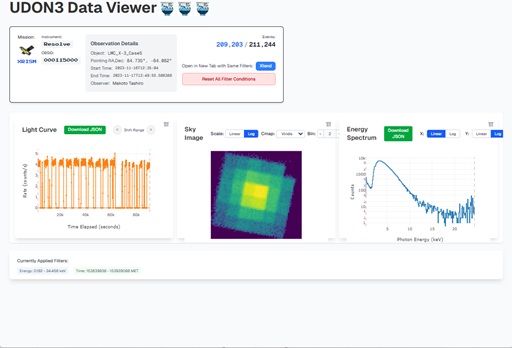
UDON3 (Universe via Darts ON-line) is a tool that allows for simple analysis of observation data from X-ray astronomy satellites available on DARTS via the web.
Main Features:
- Display of three-color composite pseudo-color images of observation data
- Plotting of spectra and light curves from observation data
- Cropping and zooming of displayed images are available
Applicable satellite:
- ASCA
- ASTRO-D
- HITOMI
- ASTRO-H
- SUZAKU
- ASTRO-E2
- XRISM
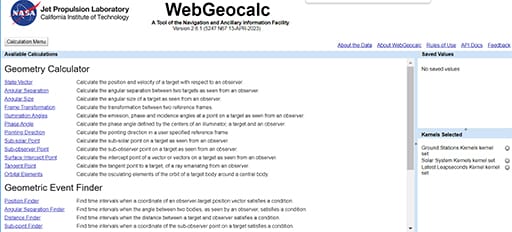
WebGeocalc (WGC) provides a web-based graphical user interface for many observation geometry calculations available in the “SPICE” system. WGC users can perform SPICE calculations without writing any programs.
Main Features:
- Geometry Calculator
- State Vector: Calculates the position and velocity of a target relative to an observer
- Angular Separation: Calculates the angular difference between two directions
- Angular Size: Calculates the angular size of a target as seen from the observer
- Frame Transformation: Calculates the transformation from one reference frame (Frame 1) to another reference frame (Frame 2)
- Illumination Angles: Calculates the emission angle, incidence angle, and phase angle at a point on the target as seen from the observer
- Phase Angle: Calculates the phase angle defined by the centers of the illumination source, target, and observer
- Pointing Direction: Calculates the pointing direction in a user-specified reference frame and outputs it as a unit vector or a full-magnitude vector expressed in a user-specified coordinate system
- Sub-Solar Point: Calculates the sub-solar point on the target as seen from the observer
- Sub-Observer Point: Calculates the sub-observer point on the target as seen from the observer
- Surface Intercept Point: Calculates the intercept point of a vector on the target as seen from the observer
- Tangent Point: Calculates the tangent point between a specified observer, a ray emitted from the observer, and the target
- Orbital Elements: Calculates the osculating elements of the target’s orbit around the central body (the orbit may be elliptical, parabolic, or hyperbolic)
- Geometric Event Finder
- Position Event Finder: Finds time intervals when the coordinates of the observer-target position vector satisfy specified conditions
- Angular Separation Event Finder: Finds time intervals when the angle between two objects as seen from the observer satisfies specified conditions
- Distance Event Finder: Finds time intervals when the distance between the target and observer satisfies specified conditions
- Sub-Point Event Finder: Finds time intervals when the coordinates of the sub-observer point on the target satisfy specified conditions
- Occultation Event Finder: Finds time intervals when the observer sees one target occulted by or transiting another target
- Surface Intercept Event Finder: Finds time intervals when the coordinates of the surface intercept vector satisfy specified conditions
- Target in Field of View Event Finder: Finds time intervals when the target intersects the space defined by the instrument’s field of view
- Ray in Field of View Event Finder: Finds time intervals when a specified ray is contained within the space enclosed by the instrument’s field of view
- Range Rate Event Finder: Finds time intervals when the range rate between the target and observer satisfies specified conditions
- Phase Angle Event Finder: Finds time intervals when the specified constraints on the phase angle defined by the centers of the illumination source, target, and observer are satisfied
- Illumination Angles Event Finder: Finds time intervals when the observed illumination angles at a surface point satisfy specified conditions
- Time Calculator
- Time Conversion: Converts time from one time system or format to another time system or format
Applicable satellite:
- HAYABUSA
- MUSES-C
- HAYABUSA2
- KAGUYA
- SELENE
- AKATSUKI
- VCO
- PLANET-C